
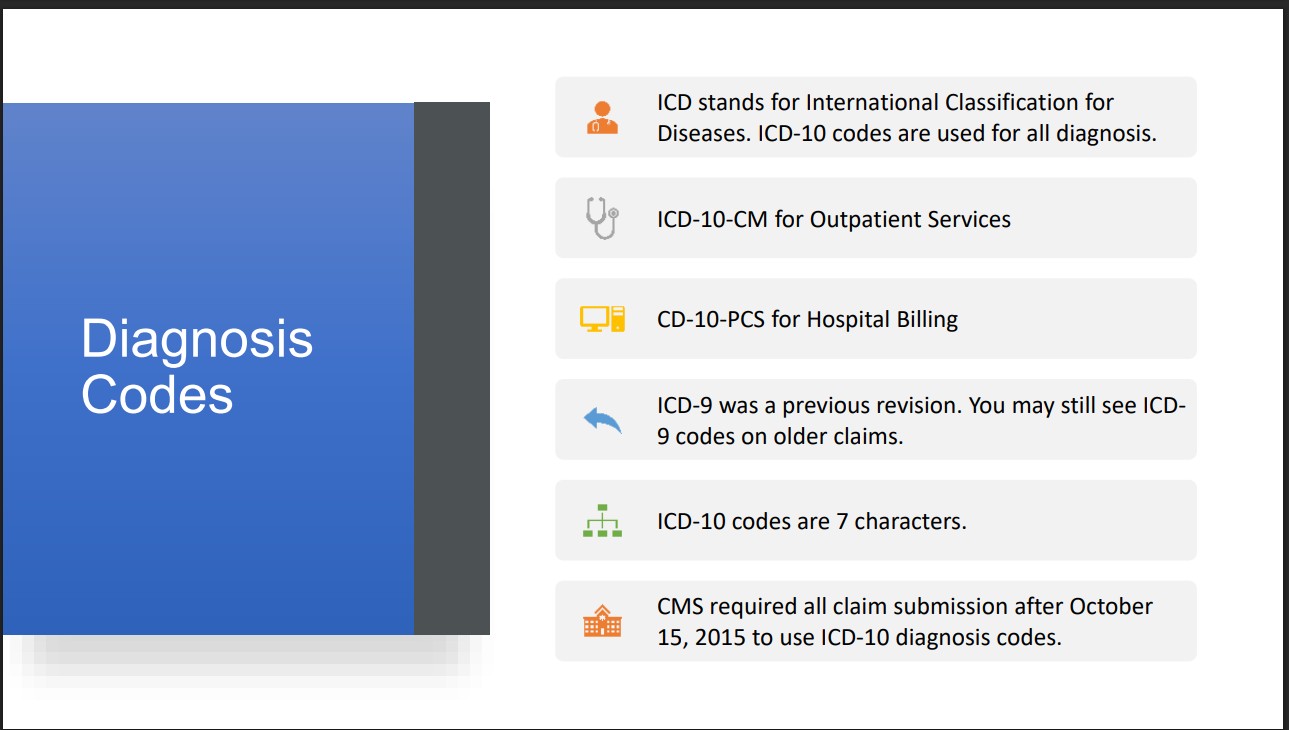
Diagnosis Codes: ICD-10
ICD-10 (International Classification of Diseases, 10th Revision) is the coding system used to describe patient diagnoses. Maintained by the World Health Organization and adapted for the United States by the National Center for Health Statistics, ICD-10 provides codes for every condition a patient might have.
There are two versions of ICD-10 used in the United States: ICD-10-CM (Clinical Modification) is used for outpatient and physician services, while ICD-10-PCS (Procedure Coding System) is used for inpatient hospital procedures. Medical billing specialists working in physician practices primarily use ICD-10-CM.
ICD-10-CM codes are alphanumeric and can have up to seven characters. The first character is always a letter, followed by numeric digits and sometimes additional letters. Codes are organized into chapters by body system or type of condition, making it possible to look up codes systematically.
The specificity of ICD-10 codes is important. Codes should be assigned to the highest level of specificity documented. Using vague or unspecified codes when more specific information is available can result in claim denials or reduced payments.
CMS mandated the use of ICD-10 for all claims with dates of service on or after October 1, 2015. The transition from ICD-9 (the previous version) to ICD-10 represented a significant change for the healthcare industry, as ICD-10 contains approximately 70,000 diagnosis codes compared to ICD-9’s 14,000.
Procedure Codes and HCPCS
Procedure codes are used to document services performed by a health care provider. The federal government established the Healthcare Common Procedure Coding System (HCPCS) years ago for Medicare and it’s been adopted by the entire industry. There are two categories of procedure codes defined by HCPCS:
- Level I
- Level II
Level I are the Current Procedural Terminology (CPT-4) codes. These are 5 digit codes. These Level I & II treatment or procedure codes are the ones medical billing is mostly concerned with on CMS-1500 claims for physician services. CPT treatment codes are maintained and copyrighted by the American Medical Association (AMA). CPT-4 is the current edition used for physician or other healthcare provider services.
Level II codes are maintained by CMS (Centers for Medicare & Medicaid Services) for non-physician services and supplies that are not covered by CPT-4 Level I codes. These codes are composed of a single letter in the range A to V, followed by 4 digits.
Treatment Code Modifiers
CPT codes may have a 2-digit alpha-numeric modifier added to the code. For example 99203 is for an initial office visit. If a “-57” were added to this code it becomes 99203-57 for initial office visit with a decision for surgery.
Modifiers are used when a procedure is performed differently than described in the normal 5-digit code. Modifiers typically indicate:
- Procedure performed by more than one physician
- Has a Professional (PC) or Technical (TC) component
- Procedure was provided more than once
- Bilateral procedure was performed
- Only part of procedure was performed
- Procedure was increased or reduced