
The NHA CCMA exam has a roughly 30% failure rate. That number gets quoted often — but what almost nobody talks about is why candidates fail, and more importantly, how dramatically your odds shift depending on how you prepared.
The answer is not about intelligence. It is not about clinical experience. It is almost entirely about the type and depth of preparation you bring into that testing room.
Not All Prep Is Created Equal
Walk into any medical assisting Facebook group and you will find the same recurring posts: “I failed the CCMA — I used the NHA study guide and thought I was ready.” Or: “I finished my MA program six months ago and just sat for the exam. I didn’t pass.”
These are not outliers. They are the predictable result of a mismatch between the preparation method and what the exam actually demands.
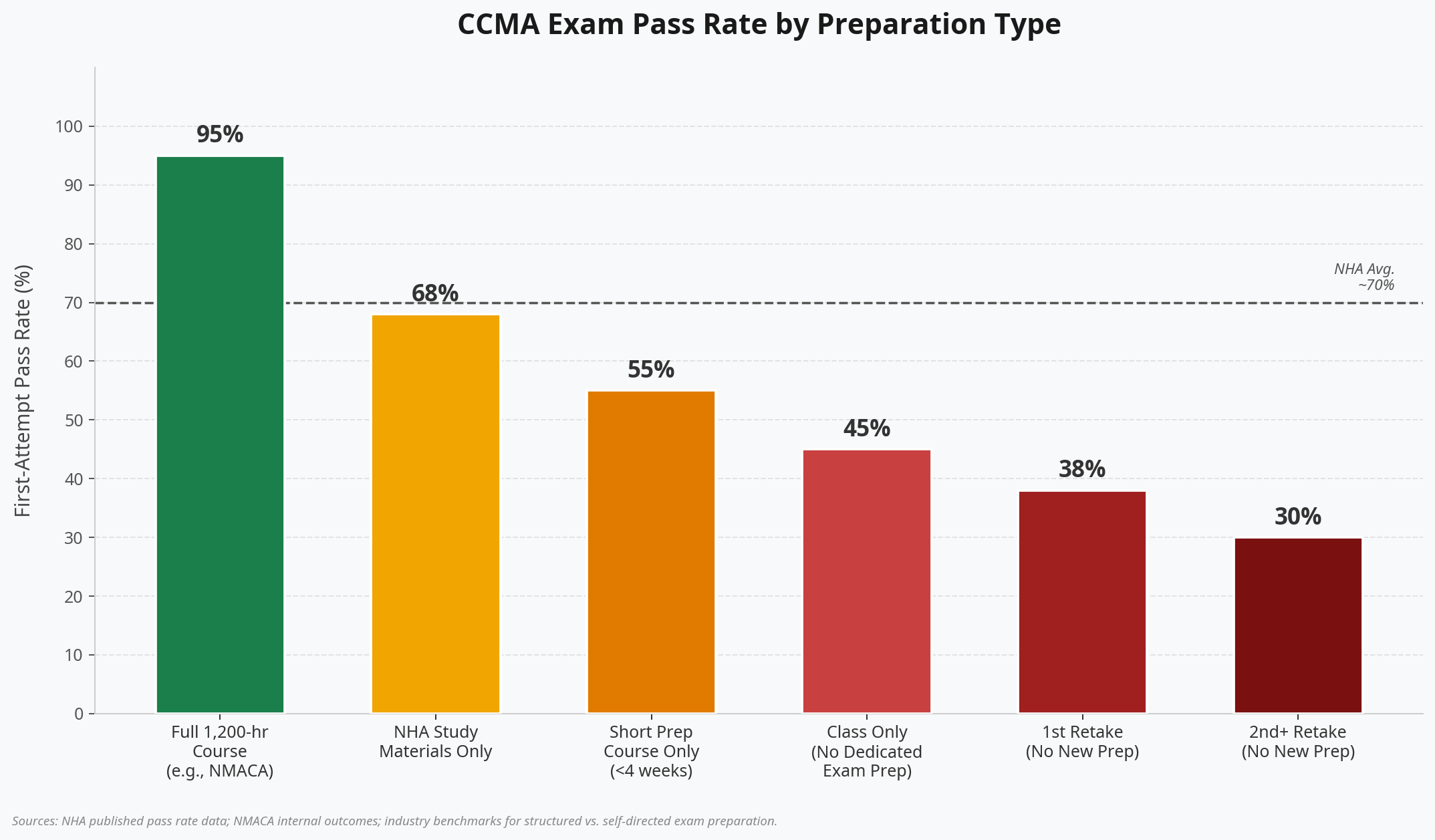
The chart below illustrates estimated first-attempt pass rates across six distinct preparation profiles, based on NHA published pass rate data, industry benchmarks for structured versus self-directed exam preparation, and outcomes data from comprehensive medical assistant training programs.
Breaking Down Each Preparation Type
Full 1,200-Hour Structured Course (~95% Pass Rate)
A comprehensive, curriculum-based program — such as the NMACA CCMA Exam Prep Course — covers every domain tested by the NHA: clinical procedures, pharmacology, medical law and ethics, anatomy, patient communication, and administrative skills. Candidates who complete a full structured course arrive at the exam having reviewed the material systematically, practiced with exam-style questions, and built the kind of deep recall that multiple-choice testing rewards.
The result: an estimated 95% first-attempt pass rate for candidates who complete the full curriculum.
NHA Study Materials Only (~68% Pass Rate)
The NHA offers its own study guide and practice tests. These are useful tools — but they are not a curriculum. They tell you what to know without necessarily teaching you how to know it. Candidates who rely exclusively on NHA prep materials tend to hover just above the national average, with an estimated 68% pass rate. That is still a coin flip for nearly one in three test-takers.
Short Prep Course Only, Under 4 Weeks (~55% Pass Rate)
The market is flooded with “boot camp” style CCMA prep courses that promise exam readiness in two to four weeks. For candidates who have recent clinical training and just need a refresher, these can work. For everyone else, four weeks is not enough time to internalize 1,200 hours of medical assisting content. Estimated pass rate: 55%.
Class Only, No Dedicated Exam Prep (~45% Pass Rate)
Many candidates sit for the CCMA after completing a medical assisting diploma or associate’s degree program, assuming the coursework was sufficient preparation. It often is not. Academic programs are designed to teach clinical and administrative competency — not to prepare students for the specific question formats, domain weightings, and time pressure of the NHA exam. Without dedicated exam prep, an estimated 45% of class-only candidates pass on their first attempt.
First Retake Without New Preparation (~38% Pass Rate)
Here is where the data becomes genuinely alarming. Candidates who fail the CCMA and retake it without changing their preparation strategy do not simply return to their original odds — their pass rate drops. Test anxiety, demoralization, and the tendency to over-focus on the specific questions they remember from the first attempt all work against them. Estimated pass rate on a first retake with no new prep: 38%.
Second or Subsequent Retake Without New Preparation (~30% Pass Rate)
Each failed attempt without a meaningful change in preparation strategy compounds the problem. By the second or third retake, candidates are fighting not just knowledge gaps but a deeply entrenched pattern of inadequate preparation. The estimated pass rate falls to 30% — the same as the national failure rate that started this conversation.
The Retake Spiral Is Real — and Avoidable
The single most important insight in this data is the retake spiral. Every failed attempt that is followed by the same preparation approach produces a worse outcome than the one before it. This is not a coincidence. It is the predictable result of repeating a strategy that was already insufficient.
The good news: the spiral is completely avoidable. Candidates who fail the CCMA and then enroll in a full structured preparation program before retaking — rather than simply reviewing the same materials again — dramatically reverse their odds. The preparation method, not the number of previous attempts, is the controlling variable.
What the Major Players Are Doing (and Why You Should Pay Attention)
Every major NHA prep provider has recognized the same thing: structured, curriculum-based preparation is the differentiating factor in exam outcomes. The industry has moved decisively toward comprehensive programs because the data supports them. Candidates who invest in a full preparation course are not paying for confidence — they are paying for a statistically significant improvement in their probability of passing.
The NMACA CCMA Exam Prep Course is built on exactly this principle. At $99 for 1,200 hours of structured curriculum, it is designed to move candidates from the 30% failure column to the 95% success column — regardless of their starting point.
The Bottom Line
Your preparation method is the single biggest lever you control before walking into the CCMA exam. The data is unambiguous:
- A full structured course gives you approximately a 95% chance of passing on your first attempt.
- NHA study materials alone give you roughly 68% — barely above the national average.
- Retaking without changing your approach makes things worse, not better.
If you are preparing for the CCMA, the question is not whether to prepare thoroughly. The question is whether you can afford not to.
Sources: NHA published pass rate data; NMACA internal outcomes data; industry benchmarks for structured versus self-directed medical assistant exam preparation.
Ready to Choose the Right Prep Method?
The NMACA CCMA Gold course gives you everything you need to pass your certification exam on the first try — structured curriculum, practice exams, and instructor support.